

MSU Health Care Sports Medicine helps strengthen student-athlete safety in Michigan schools
August 17, 2026 - Amy Soper
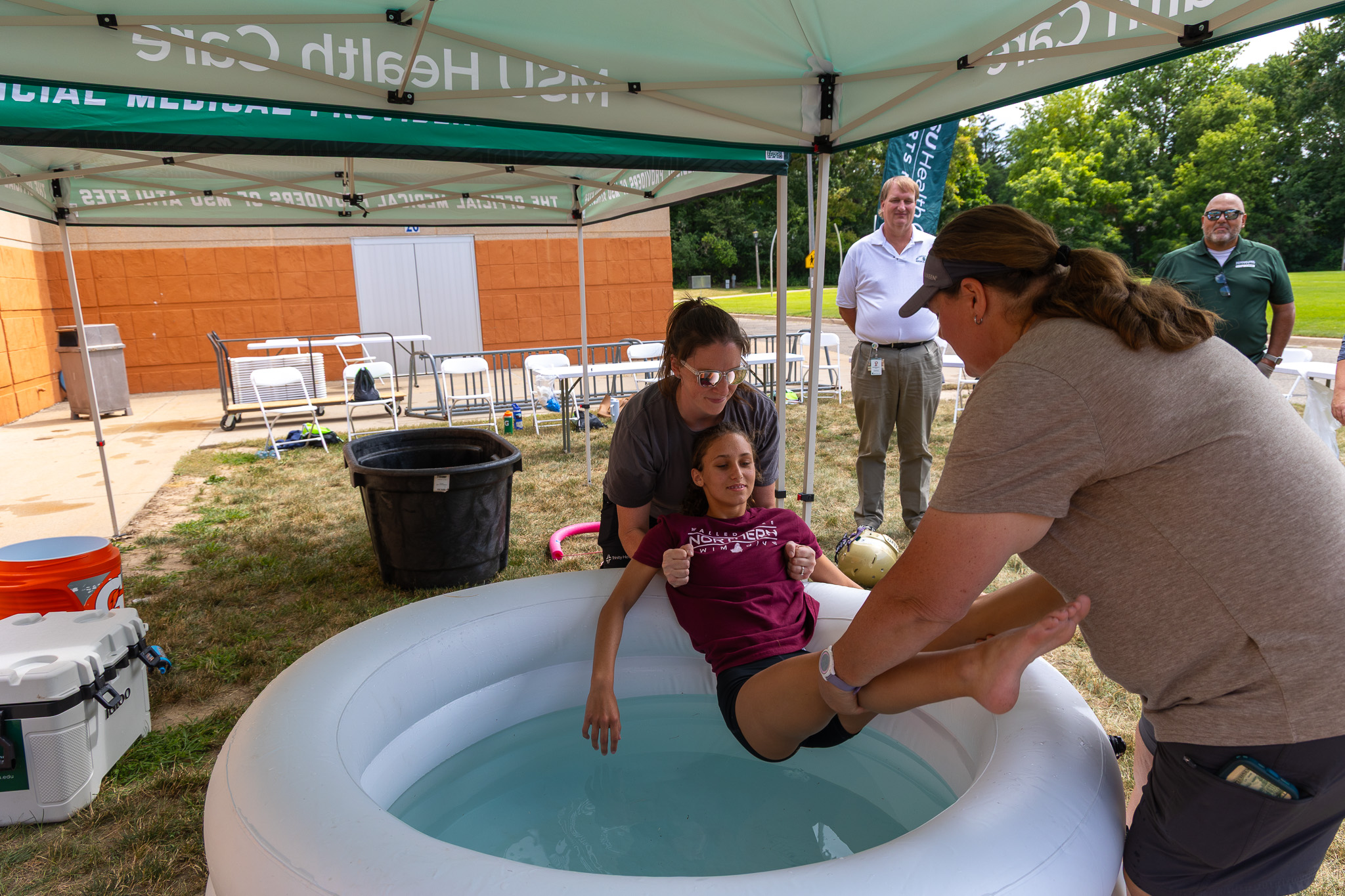
When a student-athlete suffers a serious injury, cardiac event or heat-related illness, preparation can make all the difference.
To help schools strengthen their emergency response plans, MSU Health Care Sports Medicine hosted a full-day sports safety training event July 22 at East Lansing High School. The event brought together high school coaches, athletic trainers, athletic directors and sports program leaders from across the Lansing area for hands-on emergency preparedness education.
“Every year athletic trainers need to practice their emergency action plans,” said Martha Munsell, an MSU Health Care Sports Medicine athletic trainer at Fowlerville High School and organizer of the event. “A lot of our job is reacting to what happens during an athletic event, whether it’s a practice or game situation. A group event, like this one, allows us to work with other athletic trainers and learn from each other in different situations and scenarios.”
Participating in sports can expose athletes to risks ranging from heat illness and cardiac emergencies to traumatic injuries. Having trained staff, proper equipment and a well-developed emergency action plan (EAP) can improve response times and help protect athletes during critical situations.
According to Munsell, practicing emergency scenarios allows athletic trainers, coaches and other staff members to work through real-world challenges before an emergency occurs. EMS response times, the location of the nearest emergency room, and whether a high school has an athletic trainer, can all affect what happens.
Practice today, preparation for tomorrow
Participants who attended a morning session completed a hybrid first aid, CPR and automated external defibrillator (AED) certification or recertification course. The afternoon program focused on EAP development and implementation with participants rotating through hands-on stations. Participants learned how to properly remove football equipment from an injured athlete, manage spinal injuries, stop a wound from bleeding, help someone experiencing a diabetic or breathing emergency, perform CPR and treat heat-related illnesses.
The training program is now in its fourth year.
Munsell said the event was originally developed to support Michigan High School Athletic Association requirements that schools maintain EAPs for athletic venues and events. This year’s event included 24 attendees representing high schools throughout the Lansing area, as well as a few from outside the region.
MSU Health Care Sports Medicine staff members participating in this year’s program included Munsell, Heidi Lucke, Katie Petty, Carolina Hernandez, Hannah McLain-McConnell, Rachel Weiss and Jessica Gude.
“Our athletic trainers wanted a way to practice our skills,” Munsell said. “Opening this program up to others is a way to give back to our profession and boost the presence of MSU Health Care Sports Medicine within the surrounding area.”
The benefits extend beyond the training day itself. Munsell said athletic trainers have contacted her after responding to emergencies at their schools.
“I’ve had several athletic trainers reach out after an incident has happened to them at their schools,” Munsell said. “In each incident it was a cardiac emergency that had a positive outcome from implementing the cardiac chain of command with an AED available and bystanders being able to recognize and react to the situation.”
Training that strengthens local athletic programs
Lauren Penninga, athletic trainer at Pewamo-Westphalia High School, said the training offered an opportunity to refresh skills that may not be used every day but can prove crucial when needed.
“I learned a lot more about how to manage diabetic individuals in athletics,” Penninga said. “I plan to order a glucometer to use as another vital-sign metric with my athletes.”
MSU Health Care Sports Medicine serves as the official medical provider for Michigan State University Athletics while also supporting youth and community sports throughout the region.
Programs such as the EAP training even extend that expertise beyond college athletics, helping schools, coaches and athletic trainers build the knowledge and confidence needed to respond when emergencies occur.
As participation in school sports continues to grow, organizers say proactive planning remains one of the most effective ways to protect athletes.
“Just like athletes practice specific sports drills to better themselves, athletic trainers need to practice our skills to help them during their athletic competitions,” Munsell said. “Our drills just happen to revolve around cardiac, breathing or musculoskeletal injuries.”